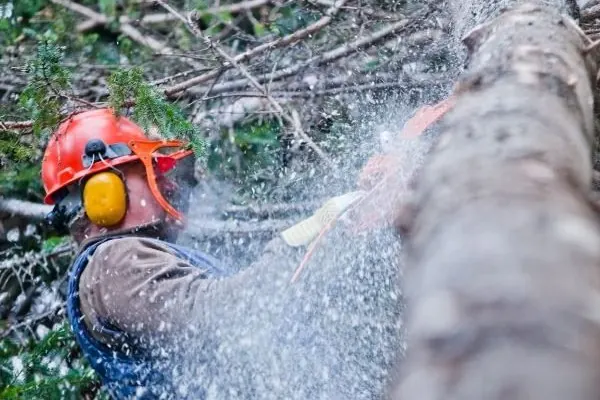
When removal is the right answer
Most healthy trees are worth keeping, and a good contractor will tell you if pruning would solve the problem. Removal makes sense when:
- The tree is dead or in decline. Dead wood becomes brittle and harder to climb safely the longer it stands.
- It has started to lean or lift. An old, steady lean is often fine. A new lean with cracked or heaving soil on one side is not.
- A main fork or trunk has split. Tight V-shaped forks with bark trapped between the stems are a common failure point in eucalypts and some exotics.
- It is in the wrong place. Against the house, lifting paths, cracking a retaining wall or standing where an extension, garage or pool is going.
- It keeps dropping limbs over a roof, driveway or play area.
- It is an environmental weed such as desert ash, sweet pittosporum or cotoneaster, which spread readily in Melbourne gardens and nearby bushland.
How a tree comes down on a Melbourne block
Very few suburban removals are a single cut at the base. Melbourne blocks have shrunk, houses sit close to boundaries, and inner-suburb lots often have laneway access only.
The on-site inspection
Before a price is given, the contractor checks the species and condition of the tree, the distance to buildings, fences and wires, and how wood and equipment will get in and out. Narrow side paths, steep driveways, solar panels, garden sheds and underground services all change the method. Point out anything you want protected at this stage.
Sectional dismantling
Where there is no room to drop the tree, a climber or an elevated work platform takes it apart from the top. Small branches come off first, then the larger limbs and trunk in short lengths. Heavier pieces are tied off and lowered on ropes through a friction device at the base, so they come down under control rather than landing on the roof or fence.
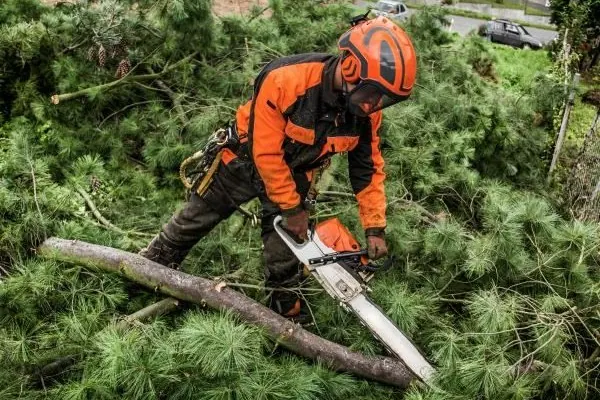
Felling
Where there is clear ground longer than the tree is tall, such as a larger outer-suburb block, the tree may be felled in one piece or in a few large sections. It is quicker and usually cheaper, but it needs space and a predictable lean.
Clean-up
Branches go through a chipper on site. Logs are cut into lengths that can be carried out, or left as firewood if you ask. Paths are swept and the ground raked. If you want the mulch for garden beds, say so when you book.
Melbourne trees that come up again and again
- Lemon-scented gums and spotted gums planted in the 1970s and 1980s that are now taller than the house.
- Monterey cypress and pine windbreaks on older and peninsula blocks, often too big for the lot they now share with a house.
- Desert ash and elms in the inner north and inner east, with roots under paths and drains.
- Remnant manna gums, messmates and swamp gums in the eastern foothills and around the peninsula, which are often the trees most likely to need a permit.
- Liquidambars and Chinese elms dropping limbs over driveways.
Before you book: permits, power and neighbours
Council and planning rules. Overlays in your council's planning scheme and some councils' local laws can require a permit before a tree on private land is removed. Native vegetation has its own state controls. Read the Melbourne tree removal permit guide and check with your council if there is any doubt.
Power lines. Mention any wires running through or near the canopy. Work near powerlines has to be carried out by people authorised for it.
Neighbours. If the tree sits on a boundary or overhangs next door, talk to your neighbour before the work is booked. If the tree is theirs, the decision is theirs too.
Paperwork. We ask the contractors we work with to hold the licences and insurance the job needs. Ask to see them before work starts.
Tree removal costs
Removal is priced on site because access and what is beneath the tree affect the price as much as height. Planning bands for 2026 are on the tree removal cost page, along with the factors that move a quote up or down. Once the tree is down you can choose to grind the stump or have it dug out.