Brunswick blocks and why they shape the job
Brunswick was built in a hurry in the late 1800s and early 1900s, and much of it still looks that way: rows of single-fronted terraces and workers' cottages on narrow lots, with brick and bluestone laneways running behind them. Add interwar houses, postwar flats and the apartments now lining Sydney Road and the Upfield rail corridor, and you get a suburb where almost every tree is close to a building, a fence or a neighbour.
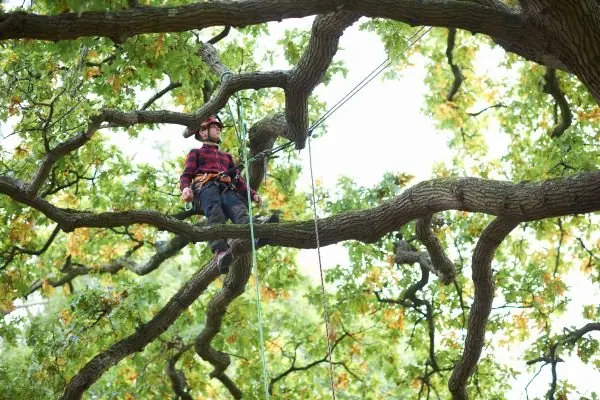
That means very little tree removal in Brunswick involves felling. A climber works the tree from the top down, cutting small sections and lowering them on ropes. Wood is carried out through a side path or down the yard to the laneway, where a chipper can run. If the laneway is narrow or shared, the crew needs to plan where the truck and chipper will sit, and for how long.
The trees Brunswick backyards end up with
Many of the trees in Brunswick yards were never planted deliberately. Desert ash spreads easily across the inner north and often comes up against a back fence, growing fast into a tall, heavy tree that drops limbs and sends roots under paths. Chinese elms and other self-seeders do the same.
Then there are the trees people did plant: figs and olives in the gardens of families who settled here after the war, lemon-scented gums from the 1970s and 1980s, peppercorns, and the occasional old cypress hedge that has become a row of trunks. Some of these are worth keeping with a prune; others are simply too big for a ten-metre-wide yard.
Heavy clay and old pipes
Brunswick sits on heavy clay soils, and parts of the area are on basalt. Clay shrinks and swells as it dries and wets, and big trees close to a house are often part of the conversation when cracks appear. Old terracotta sewer and stormwater lines in Victorian-era lots are also a common target for roots. If roots are the reason for removal, the stump may need digging out rather than grinding so the pipes can be repaired. See stump removal.
Heritage and council rules in Merri-bek
Brunswick is one of the most heritage-heavy parts of Merri-bek. Many streets fall inside Heritage Overlay precincts in the planning scheme, and a Heritage Overlay can include controls on removing trees. Merri-bek City Council may also have local-law requirements for larger trees on private land. Do not assume a backyard tree is exempt. Check the overlays on your property and ask the council before any work is booked. Our permit guide explains how the different controls fit together.
For pricing, see the tree removal cost guide. We ask the contractors we work with to hold the licences and insurance the job needs; ask to see them before work starts.
Jobs we are asked about in Brunswick
- Desert ash in the back corner. A fast-growing weed tree that self-seeds through the inner north, often planted by birds against a fence and now taller than the house.
- A fig or olive outgrowing the yard. Old fruit trees planted decades ago, now shading the whole backyard and dropping fruit on paving.
- Roots in the sewer or under the path. Elms and ash near old terracotta pipes and brick paths, common on Victorian-era lots.
- Clearing for a rear extension or granny flat. A tree standing where the new building footprint goes, removed and the stump dug out for the builder.
Calling about a Brunswick property? Use the Brunswick line, (03) 4708 5418, or the form below.
Answers to the questions we hear most
Do I need a permit to remove a tree in Brunswick?
It depends on your property. Much of Brunswick is covered by Heritage Overlay precincts in the Merri-bek planning scheme, and some overlays include tree controls. Merri-bek may also have local-law requirements for larger trees. Check the overlays on your title and ask the council before booking.
Can a tree be removed if the only access is the laneway?
Usually, yes. Wood is lowered in sections and carried or barrowed out to the laneway, where a chipper can be set up. Laneway width and any parking restrictions affect the setup, so mention the access when you ask for a quote.
Is desert ash really a weed?
Desert ash is widely treated as an environmental weed in Melbourne because it seeds readily into gardens and creek corridors such as the Merri Creek. It is a common removal in Brunswick backyards.
Which number do I call for Brunswick?
Call the Brunswick line, (03) 4708 5418, or use the quote form on this page with a photo of the tree and a note about the access.